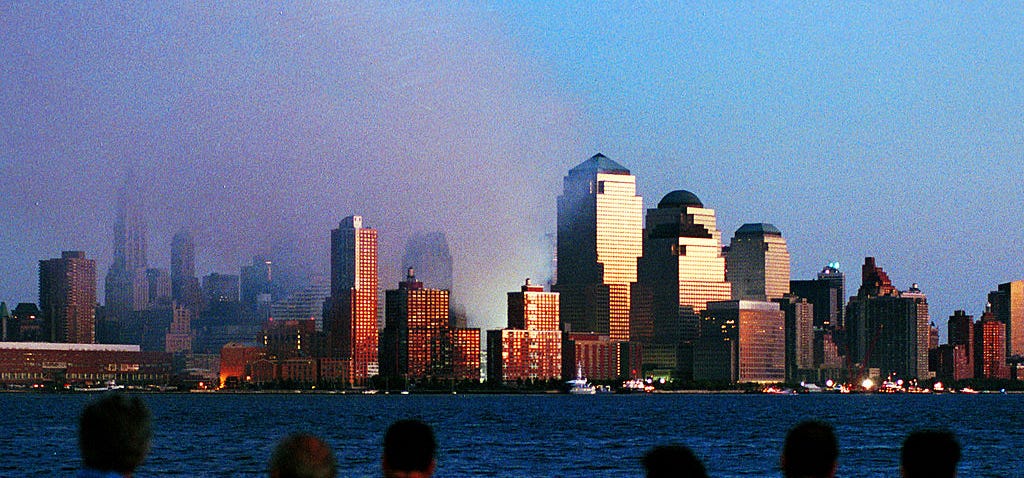
One gorgeous Tuesday morning 25 years ago, Arthur Brooks grabbed a cab from LaGuardia Airport into New York City. He was there for only a day to do a few meetings. From the Long Island Expressway, somewhere around Sunnyside, Queens, he looked out the window at the remarkable Lower Manhattan skyline. At which point, the side of the World Trade Center’s North Tower exploded.
Traffic snarled almost immediately, and within minutes, fire trucks began to race past into the Queens–Midtown Tunnel toward Manhattan. In that tunnel about 15 minutes later, he learned via the taxi’s radio that an airplane had smashed into the North Tower, and that the South Tower had now been hit as well. He got out at the corner of Fifth Avenue and 37th Street, where he had a direct view of the towers, which were both engulfed in smoke. Over the next 90 minutes, it became clear that this was no accident. He watched as the towers crumbled to the ground.
Every Free Press reader over a certain age has a story about where they were when this terrorist atrocity occurred. Many, like Brooks, witnessed it with their own eyes—or, far worse, lost friends and loved ones in the attack.
For all the horror of that day, however, most of us will also remember something very positive that happened in the immediate aftermath: America came together. This is not just a sentimental memory. According to the Pew Research Center, right before the attacks, 31 percent of Americans said that they trusted the federal government to do what was right “just about always” or “most of the time”; shortly after, that number had nearly doubled, to 60 percent, a 30-year high. New York City mayor Rudy Giuliani was widely celebrated as “America’s Mayor,” and President George W. Bush’s favorability rating sat at 90 percent by late September 2001. Volunteering rates skyrocketed, not just for 9/11-related charities, but for those unconnected with the tragedy as well.
This is an excerpt of the original article published by The Free Press. Read the full article there.